 mkaz.blog
The Wake of AI
I saw this graph posted on Hacker News recently of Stack Overflow questions over time:
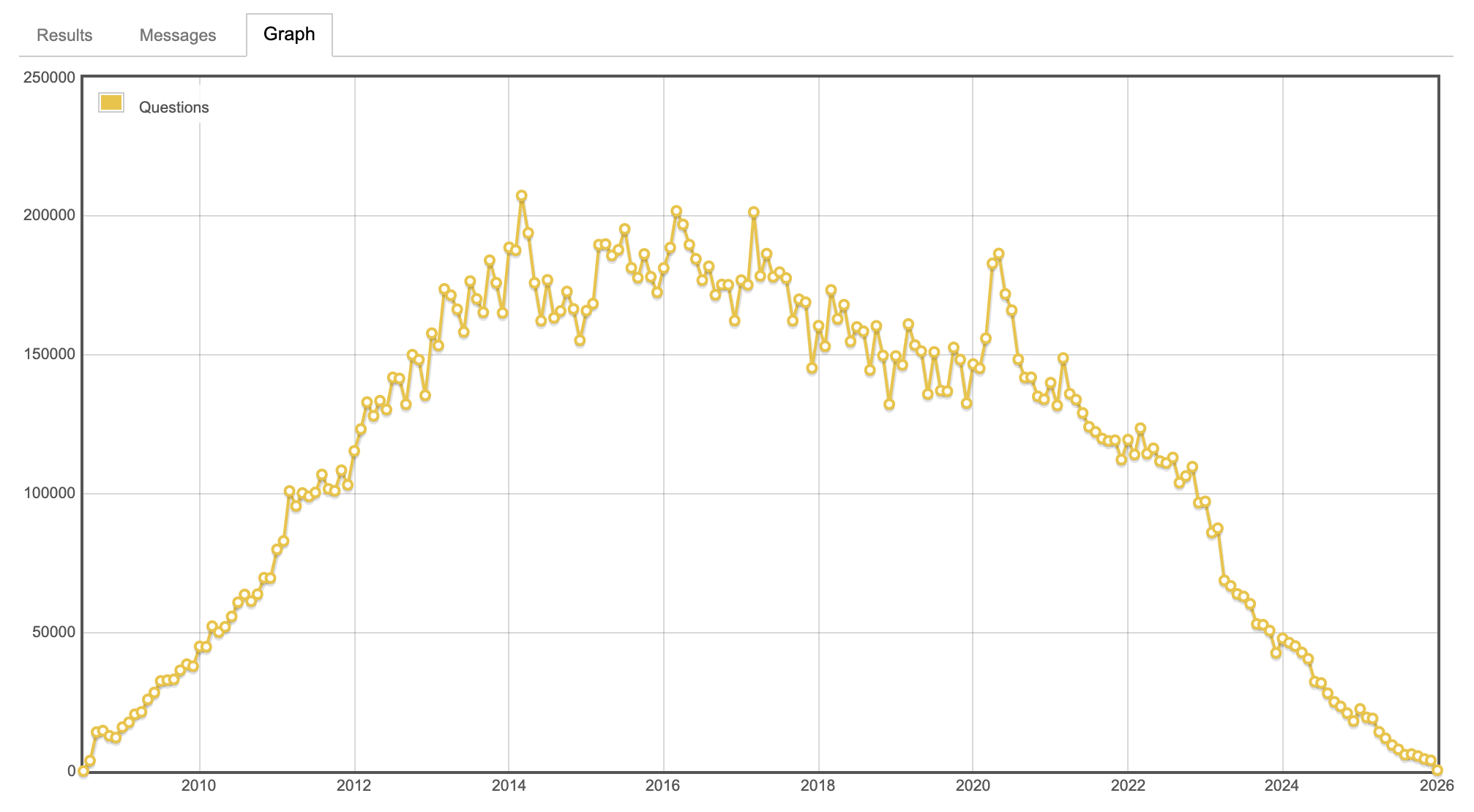
The rise from 2008 to 2014 mirrors the explosion of web development, mobile apps, and an entire generation learning to code. The plateau through 2020 represents a mature ecosystem. And then the cliff.
Starting around 2022, coinciding with the release of ChatGPT and the rise of LLMs, the number of questions asked on Stack Overflow fell off a cliff. By now it’s approaching zero. The same pattern shows up in my blog analytics. Traffic to my “Working with Python” guides, once a steady stream of developers looking up how to parse args or format strings, has dropped to a trickle.
People don’t need to ask these questions anymore. They ask their LLM.
The Howto is Dead
For three decades, a certain type of technical blog post thrived: the howto. How do I connect to a database in Python? How do I center a div? How do I parse command line arguments in Go? These posts were useful because searching Google and wading through documentation was slow and frustrating. A well-written blog post with a clear example saved time.
LLMs killed this. Why search through ten blog posts when you can ask directly and get a working code snippet tailored to your exact situation? The AI can even explain it, modify it, and debug it with you. It’s not even close to a fair fight.
This isn’t a complaint. It’s an observation. The howto blog post served a need that no longer exists in the same way. The information isn’t gone, it lives on in the training data of these models, but the delivery mechanism has changed.
What Remains
So where does this leave personal technical sites? What’s the point of writing anything when an AI can synthesize it all?
A few things remain valuable:
Opinion and perspective. AI models are trained to be helpful and balanced. They hedge. They present multiple viewpoints. What they don’t do well is take a stance and argue for it. A blog post that says “this technology is garbage and here’s why” or “everyone is doing this wrong” provides something AI cannot.
Narrative and story. The howto is dead, but storytelling isn’t. How did you solve that impossible bug? What did you learn from that failed project? What’s it actually like to work with a particular technology over years? Stories are engaging in a way that reference documentation never was.
Curation and taste. There’s more information available than ever. What’s good? What’s worth your time? A human who has explored a space and technology, who as experience, can point you to the worthwhile parts that provide real value, and what is a waste of time.
The long view. I’ve been writing online for over two decades. Some of my posts from 2010 are hilariously dated. Others turned out to be prescient. AI models have a knowledge cutoff and a kind of perpetual present tense. A blog that shows evolution of thought over time, that can say “I was wrong about this” or “I changed my mind because,” offers something different.
Writing to learn. Here’s the thing I almost forgot: I wrote most of those howtos for myself. The act of writing is an act of learning. When I documented how to format strings in Python, I wasn’t just creating a reference for others, I was forcing myself to understand it deeply enough to explain it. Learning is an active process, writing for me was a forcing mechanism to be active.
I used to reference my own site constantly. Forgot how to do something? Search my own posts. The irony is that even I don’t do this anymore, I just ask the LLM like everyone else, or even have it just generate the answers. No learning required.
This might be the most personal loss in the shift. Losing site traffic is a bummer, I enjoyed seeing people use my site to get help, but they are still getting it, just elsewhere. The real loss for me is the excuse to learn deeply by explaining clearly. It feels almost pointless to write knowing no one will read it, even when I know it helps me learn.
The Human Element
There’s something else, harder to articulate, the loss of connection. When I read a blog post from someone I’ve followed for years, there’s a relationship there. I know their quirks, their biases, their areas of expertise. I trust them differently than I trust a model that’s been trained to be generically helpful.
This matters less for “how do I parse command-line args” and more for “should I use this framework for my project.” The former has a correct answer. The latter requires judgment, context, and values that come from a specific human with specific experiences.
Maybe the era of the programming blog as a reference resource is over. Maybe what remains is the programming blog as a form of expression more essays and opinions than a manual. The howto gave us traffic and utility. What comes next might be smaller but more meaningful, though these are even harder to find without the questions guiding us.
Where to Go From Here
I’m not going to stop writing, but may have to write differently. Less “here’s how to do X” and more “here’s what I think about X and why.” Less reference material and more reflection. The AI can handle the former. The latter can still be human.
The wake of a boat is the trail it leaves behind. The wake of AI is the absence of something that used to be there an endless stream of basic questions that fueled a certain kind of content creation. In that absence, maybe we find out what was worth writing all along.